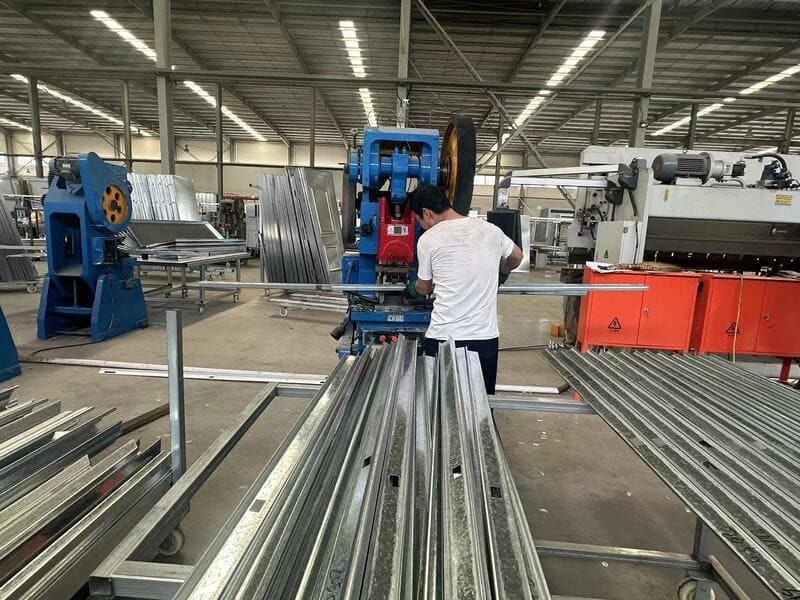
Steel Security Door Features
Engineering details that define commercial-grade steel security door performance.
Heavy-Gauge Steel Construction
Cold-rolled steel sheets ranging from 1.2mm to 3.0mm thickness with precision-bent steel shell and internal reinforcement ribs that distribute impact forces across the entire panel.
- Resists forced entry attempts including prying, bending, and cutting
- Maintains structural integrity under sustained attack
- Supports heavy-duty multi-point locking hardware
Multi-Point Locking Systems
Standard configurations include 3-point, 5-point, and 7-point systems, while maximum security applications use 12-point locking that secures the door along all four edges.
- Eliminates single-point failure vulnerability
- Provides resistance against prying along the full door height
- Enables higher resistance class ratings
Reinforced Steel Frame System
Door frames manufactured from 2.0mm to 3.0mm steel profiles with welded corners and continuous anchor tabs. Integrated strike plates at each locking point eliminate weak points.
- Matches door leaf security level for system integrity
- Prevents frame spreading and distortion
- Provides secure anchorage to masonry or concrete walls
Anti-Drill Cylinder Protection
Hardened steel anti-drill plate surrounds the cylinder pocket with manganese-alloyed steel. Rotating anti-drill pins deflect drill bits away from the cylinder mechanism.
- Stops drill attacks on lock cylinders
- Protects against picking and manipulation
- Maintains cylinder integrity under sustained attack
Security Hinge Configuration
Concealed hinges mount entirely within the door-to-frame gap. Non-removable pins and welded barrels prevent cutting. Anti-lift pins engage with frame when door is closed.
- Prevents hinge pin removal attacks
- Protects against hinge side entry attempts
- Maintains security even if hinges are damaged
Thermal and Acoustic Insulation
Internal insulation cores of mineral wool or polyurethane foam provide thermal resistance values suitable for exterior applications. Sound transmission class ratings available.
- Reduces energy costs through thermal insulation
- Controls sound transmission between spaces
- Meets building code requirements for exterior applications
Combined Fire and Security Ratings
Steel security doors achieving dual certification for fire and security performance. Intumescent seals expand when exposed to heat. Available fire ratings include 30, 60, and 90 minutes.
- Single door serves fire and security requirements
- Simplifies specification for fire-rated openings
- Reduces total project cost versus separate door types
Durable Finish Options
Powder coating in standard RAL colors or custom color matching. Decorative panels including wood veneer, stainless steel sheet, or laminate surfaces available for interior applications.
- Matches corporate branding and interior design
- Provides long-term durability in exterior environments
- Allows security doors in customer-facing locations
Security Ratings Explained
Understanding EN 1627 resistance classes for steel security doors.
The European standard EN 1627 defines resistance classes (RC) that specify how long a door assembly must withstand burglary attempts using specific tools and methods. Each class is tested according to EN 1628 (static loading), EN 1629 (dynamic loading), and EN 1630 (manual burglary attempts). Understanding these ratings helps specifiers select the appropriate security level for each application.
Selecting the Right Security Rating
Higher value assets justify higher resistance classes. Calculate potential loss against the cost difference between rating levels.
Ground-floor entries, rear doors, and locations with limited surveillance typically require higher ratings.
The resistance time should exceed the expected response time from security personnel or police.
Many commercial insurance policies specify minimum security ratings. Check policy requirements before specifying.
Some jurisdictions mandate minimum security ratings for specific building types such as banks or government facilities.
Certification Note: All Euwoo steel security doors are tested by accredited laboratories to EN 1627-1630 standards. Test reports and certificates are available for project documentation and insurance verification.
Anti-Theft Technology
How steel security doors defeat common burglary techniques.
Professional burglars use predictable attack methods against doors. Effective steel security door design incorporates specific countermeasures for each attack type. Understanding these technologies helps specifiers evaluate door quality and select appropriate protection levels.
Anti-Drill Protection
5-10+ MIN DELAYDrilling through the door leaf or lock cylinder to defeat the locking mechanism
Manganese-alloyed steel plates positioned behind the lock mechanism. The manganese content creates surface hardness that causes drill bits to overheat and fail.
Free-spinning hardened steel pins embedded in the cylinder surround. When contacted by a drill bit, they rotate rather than being cut, deflecting the bit away.
Lock cylinders certified to the highest manipulation resistance with internal hardened components tested with drill bits up to 6mm diameter.
Anti-Pry Construction
PREVENTS STANDARD TOOLSInserting crowbars or hydraulic spreaders between door and frame to force the door open
Distributing locking points along the full height eliminates leverage advantage. With 7+ points, force required exceeds practical limits for manual tools.
L-shaped steel plates welded to the door edge overlap the frame face when closed, physically blocking insertion of prying tools.
Steel brackets installed at top and bottom of frame prevent attackers from spreading the frame apart with hydraulic tools.
Anti-Cut Materials
10-15+ MIN FOR RC4Using angle grinders, saws, or thermal cutting to penetrate the door leaf or cut through locks
Thicker steel takes proportionally longer to cut. RC4 doors using 2.5-3.0mm steel require extended cutting time with portable angle grinders.
Critical areas around locks and hinges incorporate hardened steel inserts that damage cutting discs and cause rapid blade wear.
Lock mechanism enclosed in welded steel box with walls thick enough to resist cutting. Box-within-a-box construction requires multiple penetrations.
Anti-Pick Lock Systems
PICK-PROOF RATEDManipulating lock pins with picks or bump keys to open without the correct key
Complex pin configurations with multiple pin rows, sidebar mechanisms, or magnetic elements. Restricted keyways prevent insertion of picking tools.
Modified pin designs that do not respond to bump key attacks. Specific geometries prevent energy transfer that bump keys rely on.
Internal components designed to jam or lock if manipulation is detected. Some cylinders include anti-pick pins that trap picking tools.
Anti-Snap Cylinder Protection
ELIMINATES SNAP ATTACKSBreaking the cylinder at its midpoint to access and turn the cam directly
Cylinders designed with sacrificial break points. When attacked, the cylinder breaks at a predetermined point but the remaining section continues to secure the door.
Solid brass or steel cylinder bodies that resist the torque required for snapping attacks. Combined with proper length selection, these don't protrude enough for leverage.
External steel guards that surround exposed cylinder portions and prevent application of torque. Anchored to door leaf independently of cylinder.
Anti-Extraction Features
PREVENTS CYLINDER PULLPulling the lock cylinder out of the door using grip tools or extraction devices
Hardened steel rosettes surrounding the cylinder face that prevent grip tools from gaining purchase. These rosettes spin freely if grabbed.
Internal fixings that secure the cylinder to the lock body independently of the external fixing screw. Cylinder remains locked even if screw is defeated.
Installing cylinder face flush with or below door surface eliminates projection that extraction tools require. Combined with smooth escutcheons prevents tool attachment.
Integrated Security System
Effective door security requires all components to work together. A door with excellent anti-drill protection but weak hinges offers an alternative attack path. Euwoo steel security doors are engineered as complete systems where every component meets the overall security rating. This includes the door leaf, frame, hinges, locks, cylinders, and all hardware. When specified correctly, the entire assembly presents no weak points for attackers to exploit.
Lock & Hardware Systems
Multi-point locking systems and security hardware for steel security doors.
The locking system determines how a steel security door resists forced entry. Euwoo steel security doors are available with various locking configurations, from 3-point systems for basic commercial applications to 12-point systems for maximum security. All hardware is selected to match the door's resistance class rating.
3-Point Locking
RC2One main lock with two additional locking points (top and bottom). Three-point locking provides entry-level multi-point security suitable for residential applications and low-risk commercial areas.
- Main deadbolt with hook or bolt locking
- Automatic engagement when door closes
- Key operation outside, thumb-turn inside
5-Point Locking
RC2-RC3Main lock with four additional locking points distributed along the lock edge. The standard configuration for commercial steel security doors with significantly improved prying resistance.
- Dual latch plus three-bolt configuration
- Hardened steel bolts minimum 20mm throw
- Cylinder options from Class 4 to Class 6
7-Point Locking
RC3-RC4Main lock with six additional locking points including top, bottom, and multiple side points. Delivers high-security performance required for RC4 applications.
- Mushroom-head bolts resist manipulation
- Lock case protected by manganese plates
- Certified to EN 12209 Grade 7
12-Point Locking
RC4+Locking points on all four edges including top and bottom rails. Maximum security by engaging the door on all four sides, eliminating any edge as a potential attack surface.
- Four-way locking engagement
- Floor and header bolts for perimeter security
- Panic function with delayed egress
High-Security Cylinder Selection
Lock cylinders tested to EN 1303 that provide documented resistance to manipulation, drilling, and key extraction.
- Anti-pick pins
- Basic drill protection
- Standard key profile
- Enhanced anti-pick mechanism
- Hardened anti-drill pins
- Restricted keyway
- Key duplication control
- Maximum manipulation resistance
- Full hardened steel construction
- Patent-protected keyway
- Snap-secure design
Supporting Hardware Components
Heavy-duty hinges with non-removable pins and anti-lift features. Load capacity 120-200kg per hinge.
Surface-mounted or concealed, EN 1154 rated with adjustable speed and backcheck function.
Single-motion egress for escape routes. EN 1125 (panic) or EN 179 (emergency) rated.
Remote release for access control. Fail-secure or fail-safe operation available.
Magnetic contacts report door/lock status to security monitoring systems.
Access Control Integration
Steel security doors can be integrated with electronic access control systems while maintaining physical security ratings. Euwoo prepares doors for various access control methods:
Cable routes and mounting reinforcement
Weather protection for exterior use
Reinforced mounting areas
Video intercom compatibility
Technical Specifications
Detailed specifications for steel security door configurations.
Door Leaf Specifications
| Parameter | RC2 | RC3 | RC4 | Notes |
|---|---|---|---|---|
| Steel Thickness | 1.2mm - 1.5mm | 1.5mm - 2.0mm | 2.0mm - 3.0mm | Cold-rolled steel, galvanized base |
| Door Thickness | 45mm - 55mm | 55mm - 70mm | 70mm - 100mm | Including insulation core |
| Max Single Door Width | 1100mm | 1100mm | 1200mm | Custom widths available |
| Max Door Height | 2200mm | 2400mm | 2500mm | Taller doors may require additional locking |
| Max Double Door Width | 2200mm | 2200mm | 2400mm | Both active or one active + fixed panel |
| Door Weight | 40-60 kg | 60-90 kg | 90-150 kg | Per leaf, varies with options |
Frame Specifications
| Parameter | RC2 | RC3 | RC4 | Notes |
|---|---|---|---|---|
| Frame Steel Thickness | 1.5mm | 2.0mm | 2.5mm - 3.0mm | Welded corner construction |
| Frame Profile Depth | 60mm - 75mm | 75mm - 100mm | 100mm - 150mm | Wall anchor depth varies |
| Anchor Spacing | 600mm max | 400mm max | 300mm max | Through-bolt or chemical anchor |
| Threshold | Optional 20mm | 20mm standard | 20mm+ with floor bolts | ADA-accessible options available |
Locking System
| Parameter | RC2 | RC3 | RC4 |
|---|---|---|---|
| Min Locking Points | 3-point | 5-point | 7-point |
| Bolt Throw | 15mm min | 20mm min | 25mm min |
| Cylinder Class | EN 1303 Cl.4 | EN 1303 Cl.5 | EN 1303 Cl.6 |
| Lock Grade | EN 12209 Gr.5 | EN 12209 Gr.6 | EN 12209 Gr.7 |
Performance
| Parameter | RC2 | RC3 | RC4 |
|---|---|---|---|
| Burglary Resistance | 3 min | 5 min | 10 min |
| Static Load | Class 2 | Class 3 | Class 4 |
| Acoustic Rating | Rw 32-38 dB | Rw 35-42 dB | Rw 40-48 dB |
| U-Value | 1.8-2.2 W/m²K | 1.5-2.0 W/m²K | 1.2-1.8 W/m²K |
Standard Door Sizes
Stocked for faster delivery. Custom sizes manufactured to order.
Surface Finish Options
RAL colors, 60-80 microns, excellent UV/corrosion resistance
304/316 grade, 0.8-1.2mm, maximum corrosion resistance
Oak, walnut, maple - interior applications only
HPL in wood grains, solids, metallics - scratch-resistant
Certifications & Standards
Burglar resistance RC2-RC4
Fire resistance testing
Cylinder security class
Quality management
Construction & Materials
Materials and construction methods that define steel security door performance.
The security performance of a steel door depends on material selection, construction methods, and quality control. Understanding these elements helps specifiers evaluate door quality and compare products from different manufacturers.
Cold-Rolled Steel Sheets
Door Leaf Material
Cold-rolled steel sheets provide smooth surface suitable for painting and consistent thickness. Galvanized coating for corrosion protection before fabrication.
- Consistent thickness across entire sheet
- Galvanization for corrosion resistance
Steel Stiffeners & Reinforcement
Internal Structure
Internal steel reinforcement prevents deformation under impact. Lock zone protected by manganese-alloyed hardened steel plates for drill resistance.
- Hardened steel in anti-drill zones
- Secure attachment that won't loosen
Thermal & Acoustic Insulation
Insulation Core
Cavity filled with mineral wool (fire-resistant) or polyurethane foam (thermal performance). Factory-injected to fill all cavities without gaps.
Steel Frame Profiles
Frame Construction
Formed steel profiles with welded corners. Integrated strike pockets at each locking point. Frame must match door leaf security level.
- Welded corners, not just bent
- Integrated strike pockets
Manufacturing Process
CNC cutting, deburring, inspection
CNC press brakes, precision bends
Spot/MIG welding, lock zone assembly
Cleaning, conversion coating
Electrostatic spray, oven cure
Locks, hinges, closers
Dimensional, coating, function test
Quality Assurance
Steel verified for thickness, coating weight, surface quality. Mill certificates retained.
Critical dimensions verified at forming, welding, and assembly stages.
Film thickness measured. Adhesion tested per ISO 2409 cross-cut method.
Samples tested to EN 1627-1630 at accredited labs. Reports available.
Applications
Steel security door applications across commercial, industrial, and residential sectors.
Retail Stores & Commercial Buildings
RC3-rated steel security doors provide 5-minute resistance time allowing alarm systems to alert authorities. Powder-coated finishes maintain retail aesthetics while delivering commercial-grade protection.
- Meets insurance requirements
- Professional appearance
- Reduces insurance premiums
Warehouses & Industrial Facilities
Heavy-gauge steel frames withstand forklift impact. Galvanized substrates and industrial coatings resist corrosion. RC4 doors available for controlled substances and hazardous materials.
- Protects valuable inventory
- Withstands harsh environments
- Meets regulatory requirements
Banks & Financial Institutions
RC4-rated doors deliver 10-minute resistance against professional attackers. Time-delay locks, access logging, and decorative finishes maintain professional image while providing bank-grade security.
- Exceeds banking standards
- Provides audit trail
- Projects trustworthiness
Data Centers & IT Facilities
RC4 physical security combined with biometric access control. Mantrap configurations and no external hardware prevent tailgating. Integrated monitoring for security operations centers.
- SOC 2, ISO 27001, HIPAA compliant
- Biometric integration
- Audit logging
Government & Institutional Buildings
RC3 for administrative areas, RC4 for evidence rooms and secure storage. ADA-compliant options for public access. Emergency lockdown support.
- Government security specs
- ADA-compliant options
- Emergency lockdown
Industry-Specific Requirements
Pharmacies and controlled substance storage require RC4. Anti-microbial finishes and vision panels for observation.
Lockdown capability with panic hardware. Classroom security locks and remote lockdown capability.
Back-of-house security with decorative guest-facing options. Electronic access control with audit logging.
Customization Options
Configure steel security doors for your specific application requirements.
Euwoo manufactures steel security doors to customer specifications. Beyond standard sizes and configurations, we offer customization for dimensions, finishes, hardware, and special features. Our engineering team works with clients to develop solutions that meet project requirements while maintaining security certification.
Size Customization
Single doors can be manufactured up to 1200mm wide, double doors up to 2400mm combined width. Non-standard widths are manufactured to exact specifications with appropriate frame profiles.
Standard heights extend to 2500mm for most security ratings. Taller doors up to 3000mm can be manufactured with reinforced construction and additional locking points.
Doors can be manufactured with reduced heights for basement entries, mezzanine access, or renovation projects with limited headroom.
Finish Options
Powder coating in any RAL color from the full RAL Classic range. Custom color matching is available for corporate branding or architectural specifications.
Sample panels can be provided for color approval. Metallic and special effect finishes available at additional cost.
304 or 316 grade stainless steel face sheets for maximum corrosion resistance. Available in brushed, mirror, or patterned finishes.
Adds 3-5kg per square meter to door weight. 316 grade recommended for coastal or chemically aggressive environments.
Real wood veneer applied over steel substrate for interior applications. Oak, walnut, maple, and custom species available.
Interior use only. Veneer requires periodic maintenance. Not available with fire rating.
High-pressure laminate in hundreds of patterns including wood grains, solid colors, and metallic effects.
Suitable for interior or sheltered exterior. More scratch-resistant than wood veneer.
Hardware Configuration
Choose from multiple high-security lock manufacturers to match existing master key systems or preferred brands. Options include European, American, and Asian manufacturers.
Note: Lock selection must meet minimum EN 12209 grade for the door's security rating.
Select cylinder brand, profile, and keying options. Master key systems, construction keying, and restricted keyway options available.
Note: Coordinate with locksmith for complex master key systems. Restricted keyway cylinders require authorization documentation.
Range of handle designs from industrial to architectural. Stainless steel, aluminum, and brass finishes available.
Note: Handle design affects door thickness and lock engagement. Some decorative handles may require adapters.
Surface-mounted or concealed door closers with adjustable closing force and speed. Options for hold-open, fire-rated, and barrier-free applications.
Note: Door closer must be sized for door weight and width. Fire-rated doors require listed closers.
Special Features
Glazed panels for visibility through the door. Security glass options include laminated, polycarbonate, and security-rated glass that maintains the door's resistance class.
Louvered or perforated sections for air transfer. Security louvres prevent passage of objects while allowing airflow.
Stainless steel or aluminum kick plates for high-traffic areas. Standard heights 200mm, 300mm, or custom.
Factory preparation for card readers, keypads, electric strikes, or magnetic locks. Includes cable routing, reinforcement, and cut-outs.
OEM/ODM Programs
Euwoo supports OEM and ODM programs for distributors, contractors, and security companies requiring customized products or private labeling.
Doors manufactured to your specifications with your branding, labels, and documentation.
Engineering support to develop new door designs for specific market requirements or applications.
Reserved production capacity for high-volume customers with consistent specifications.
How to Order Custom Doors
Provide door schedule with dimensions, security rating, finish, and hardware requirements.
Our team reviews specifications for feasibility and security compliance.
Detailed quotation with unit prices, tooling charges, and delivery timeline.
Production drawings provided for approval. Physical samples available for critical projects.
Manufacturing scheduled upon order confirmation. Status updates provided.
Minimum Order Quantities
Typical Lead Times
Steel Security Doors vs. Alternatives
Compare steel security doors with other door types for informed specification decisions.
Selecting the right door type depends on security requirements, budget, aesthetics, and environmental factors. This comparison helps specifiers understand where steel security doors excel and where alternative solutions might be appropriate.
| Feature | Steel Security | Aluminum Security | Wood Security | Fiberglass |
|---|---|---|---|---|
| Security Rating Availability | RC2 to RC6 | RC2 to RC3 | RC2 (limited) | RC1-RC2 |
| Maximum Resistance Time | 20+ minutes (RC6) | 5 minutes | 3 minutes | Limited |
| Fire Rating Options | 30-120 minutes | 30 minutes max | 30-60 minutes | 20 minutes max |
| Typical Cost Range | $$-$$$ | $$$ | $$-$$$$ | $-$$ |
| Weight (typical single door) | 60-150 kg | 40-80 kg | 50-100 kg | 30-50 kg |
| Corrosion Resistance | Good with galvanizing | Excellent | Requires maintenance | Excellent |
| Aesthetic Options | Extensive | Excellent | Traditional appeal | Good |
| Thermal Performance | Good with insulation | Requires thermal break | Natural insulator | Excellent |
| Dimensional Stability | Excellent | Excellent | Variable with humidity | Excellent |
| Maintenance Requirements | Low | Very low | High (refinishing) | Low |
Steel vs. Aluminum
- Higher security ratings (RC4-RC6)
- Better fire resistance potential
- Lower cost at equivalent security
- Lighter weight
- Superior corrosion resistance
- Anodized finishes never need repainting
Steel vs. Wood
- Much higher security ratings
- Consistent performance regardless of humidity
- Lower maintenance over lifetime
- Traditional aesthetic appeal
- Natural insulation properties
- Historic building restoration
Steel vs. Fiberglass
- Significantly higher security ratings
- Fire rating up to 120 minutes
- Proven long-term durability
- Excellent thermal efficiency
- Lightweight for easy operation
- No corrosion concerns
Door Type by Application
| Application | Recommended Type | Min. Rating | Reasoning |
|---|---|---|---|
| Bank Vault Anteroom | Steel Security Door | RC4 | Maximum security required; steel is the only option for RC4+ |
| Retail Store Entry | Steel Security Door | RC3 | Insurance typically requires RC3; steel offers best value |
| Office Building Exterior | Steel or Aluminum | RC2-RC3 | Both suitable; choose based on aesthetics and budget |
| Coastal Resort Entry | Aluminum Security Door | RC2 | Corrosion resistance more important than maximum security |
| Historic Building Interior | Wood Security Door | RC2 | Heritage requirements may mandate wood appearance |
| Data Center | Steel Security Door | RC4 | Compliance requirements often specify steel construction |
Total Cost of Ownership Factors
Steel security doors typically cost less than aluminum at equivalent security ratings. Wood doors vary widely based on species and finish.
Heavier steel doors may require additional labor and wall reinforcement. Factor installation into total project cost.
Steel requires periodic inspection of finish for corrosion. Wood requires regular refinishing. Aluminum and fiberglass need minimal maintenance.
Quality steel doors last 25-30+ years with proper maintenance. This longevity typically makes steel the best lifetime value.
Higher security ratings may qualify for insurance premium reductions that offset higher door costs.
Installation Guide
Professional installation requirements for steel security doors.
Proper installation is critical to achieving the rated security performance of steel security doors. A door with RC4 construction installed incorrectly may fail to provide RC4 protection. This guide covers the key installation requirements that contractors must follow to maintain security certification.
Pre-Installation Requirements
Wall Construction Verification
Steel security doors require solid masonry, concrete, or reinforced wall construction. Stud walls with drywall facing cannot provide adequate anchorage.
- • Solid masonry: minimum 140mm thick
- • Concrete: minimum 150mm thick
- • Reinforced blockwork: filled and grouted cores
Opening Preparation
The wall opening must be sized to accept the frame with proper clearance for adjustment and grouting.
- • Opening width: frame width + 20-30mm clearance
- • Opening height: frame height + 10-20mm clearance
- • Surfaces cleaned of loose material
Structural Coordination
Heavy security doors require wall sections capable of supporting door weight and resisting forces during attack. For doors over 100kg, consult structural engineer.
- • Lintel capable of supporting frame and door weight
- • Wall section adequate for anchor loads
- • Floor capable of supporting threshold loads
Delivery and Handling
Steel security doors are heavy and require appropriate handling equipment. Plan for delivery access and staging area.
- • Lifting equipment for doors over 80kg
- • Protection from weather during storage
- • Staging area for frame and door assembly
Installation Procedure
Frame Positioning
Place the frame in the opening and check for plumb, level, and square. Use packers or shims to adjust frame position. The frame must be perfectly aligned for the door to close properly and locking points to engage correctly.
- • Check plumb on both jambs
- • Verify level at head and threshold
- • Confirm diagonals are equal (square)
Spirit level, plumb bob, tape measure, packers/shims
Temporary Bracing
Install temporary braces to hold frame in position during anchoring. Cross-braces prevent racking. Spreader bars maintain correct width at top and bottom.
Anchor Installation
Install anchors at all specified locations using the required anchor type. Anchor spacing and edge distances must meet minimum requirements.
Hammer drill, appropriate drill bits, torque wrench
Frame Grouting
Fill the gap between frame and wall with non-shrink grout or cement mortar. Complete filling is essential to transfer attack forces from frame to wall.
Door Hanging
Install hinges on frame if not factory-installed. Hang door on hinges and adjust for proper clearance all around. Security hinges must be fully engaged and pins secured.
Lock Adjustment
Verify all locking points engage fully with their strike pockets. Adjust strikes if needed to ensure complete bolt engagement. Check key and handle operation from both sides.
Door Closer Installation
Install door closer according to manufacturer instructions. Adjust closing speed, latching speed, and backcheck settings. Verify door closes and latches automatically from any open position.
Sealing and Finishing
Install perimeter seals if not factory-fitted. Apply sealant at frame-to-wall junction if required. Touch up any paint damage from installation.
Security ratings are tested with specific anchor types and spacings. Using incorrect anchors voids certification.
The gap between frame and wall must be filled with structural material that transfers attack forces.
Security door frames cannot be adequately anchored to lightweight construction.
Common Installation Errors
Consequence: Frame can flex under attack, allowing door to be pried open
Correction: Remove foam and fill with non-shrink grout
Consequence: Frame pulls away from wall under prying attack
Correction: Install additional anchors at correct spacing
Consequence: Locking points do not fully engage, door binds or gaps
Correction: Realign frame, re-adjust all hardware
Consequence: Door can be lifted off hinges even with hinges intact
Correction: Verify anti-lift pins engage with frame pockets
Required Documentation
Signed statement confirming installation per manufacturer requirements - required for warranty
Record of anchor type, size, and locations used - verification of correct anchoring
Photos of frame anchoring before grouting and completed installation - evidence for warranty
Technical Support
Euwoo provides technical support for installers. Contact our technical team for assistance with unusual installations, wall conditions, or hardware questions.
Steel Security Door FAQs
Common questions about steel security door specifications, ordering, and applications.
Security Ratings & Standards
How do I determine which RC rating is appropriate for my application?
The appropriate RC rating depends on asset value, location risk, and response time. For residential properties and low-risk commercial storage, RC2 provides adequate protection with 3-minute resistance. Most commercial retail and office applications specify RC3, which resists attacks for 5 minutes using crowbars and drills. High-value facilities including banks, data centers, and jewelry stores typically require RC4, offering 10-minute resistance against power tools. Insurance requirements and local regulations may also mandate specific ratings. Our technical team can help assess your risk profile and recommend appropriate security levels.
How are steel security doors tested for their RC rating?
Steel security doors are tested according to EN 1627-1630 standards by accredited testing laboratories. EN 1628 tests resistance to static loads such as prying forces. EN 1629 tests dynamic resistance including impact loading. EN 1630 involves manual attack testing where skilled testers attempt to defeat the door using the tool set defined for each resistance class. The door must prevent through-passage and prevent the lock from being operated for the defined time period. Euwoo provides test reports from accredited laboratories documenting the security rating of each door model.
Can a steel security door also be fire-rated?
Yes, steel security doors can be manufactured with combined fire and security ratings. These dual-rated doors undergo separate testing for fire resistance (EN 1634-1) and security (EN 1627). The construction must satisfy both requirements, which means careful engineering of seals, glazing if present, and hardware. Fire ratings of 30, 60, and 90 minutes are available depending on the security rating and configuration. Note that not all combinations are possible, particularly at higher fire ratings with vision panels. Contact our engineering team early in the project to confirm available options for your specific requirements.
Product Specifications
What steel thickness is used in security doors?
Steel thickness varies by security rating. RC2 doors typically use 1.2-1.5mm cold-rolled steel for the door leaf skins. RC3 doors increase to 1.5-2.0mm thickness. RC4 doors use 2.0-3.0mm steel with additional hardened steel plates in the lock zone. Frame profiles use similar or heavier gauges. These thicknesses represent the skin material; internal reinforcement adds significant additional steel in critical areas. All steel is galvanized before fabrication for corrosion protection, then powder coated for durability and appearance.
How much does a steel security door weigh?
Door weight depends on size, security rating, and options. A standard single RC2 door (900x2100mm) weighs approximately 40-60kg. RC3 doors of similar size weigh 60-90kg. RC4 doors can weigh 90-150kg or more. Adding fire rating, vision panels, or stainless steel cladding increases weight further. Frame weight adds another 30-60kg depending on configuration. Heavy doors require appropriate hinges (typically three or four per leaf) and may require reinforced floor construction and assisted closing devices. We provide exact weights with each quotation.
What is the maximum size for steel security doors?
Maximum dimensions depend on security rating and configuration. For single doors, typical maximums are 1100-1200mm wide and 2400-2500mm tall. Double doors can reach 2400mm combined width. Height over 2400mm requires additional locking points to maintain security. Very large openings may be served by paired doors or door-and-sidelight combinations. Custom sizes are manufactured to order. For openings exceeding these dimensions, contact our engineering team to discuss solutions including sectional security doors or custom assemblies.
Locking & Hardware
How many locking points does a steel security door need?
Minimum locking points increase with security rating. RC2 requires at least 3-point locking. RC3 typically uses 5-point or 7-point systems. RC4 and above often specify 7-point or 12-point locking. The number of points should match door height, with taller doors requiring more points to prevent prying along the full height. Twelve-point systems that lock on all four edges provide maximum security for vault-level applications. More locking points increase security but also add weight and cost. Our specifications indicate appropriate configurations for each door size and rating.
Can steel security doors be integrated with electronic access control?
Yes, steel security doors can be fully integrated with access control systems. Options include electric strikes for fail-secure or fail-safe operation, electromagnetic locks, electric latch pullback on multi-point locks, and motorized locking. Doors can be factory-prepared for card readers, keypads, biometric readers, and intercom systems with appropriate cable routing and mounting reinforcement. We coordinate with access control specifiers to ensure correct preparation. For complex systems, provide access control specifications when ordering so we can engineer appropriate door preparation.
What key and cylinder options are available?
We supply doors with high-security cylinders from major European and Asian manufacturers. Options include standard keyed cylinders, master key systems, construction keying, and restricted keyway cylinders that prevent unauthorized key duplication. Cylinder security class matches the door's RC rating: Class 4 minimum for RC2, Class 5 for RC3, and Class 6 for RC4. For projects requiring specific cylinder brands to match existing key systems, we can accommodate most major brands. Electronic cylinders and smart lock systems are also available for advanced access management.
Ordering & Lead Times
What is the minimum order quantity for steel security doors?
Minimum order quantities depend on door configuration. Standard specifications with stock finishes have a minimum of 20 units. Custom sizes or special finishes may have minimums of 10-20 units. OEM/ODM programs with private labeling typically require 50+ units. For sample or prototype orders, we can sometimes accommodate smaller quantities with adjusted pricing. Contact our sales team to discuss your specific requirements and volume expectations.
What is the typical lead time for steel security doors?
Lead time depends on configuration and order size. Standard configurations ship in 20-30 days from order confirmation. Custom sizes or special finishes add 10-15 days. Large project orders are scheduled based on production capacity and may be delivered in phases. Fire-rated and dual-certified doors may require additional lead time. For urgent requirements, contact us to discuss expedited production options. We recommend ordering 8-12 weeks before required installation date to allow for production, shipping, and any unforeseen delays.
How is pricing structured for steel security doors?
Pricing is based on door size, security rating, finish, and hardware configuration. RC2 doors cost less than RC3, which costs less than RC4, reflecting the increased material and engineering content. Custom sizes, special finishes like stainless steel cladding, and premium hardware add to base pricing. Volume orders receive progressive discounts. We provide detailed quotations itemizing each component. For budget planning, contact us with approximate specifications and quantities for preliminary pricing.
Installation & Maintenance
What wall construction is required for steel security door installation?
Steel security doors require solid wall construction for proper anchoring. Acceptable materials include concrete (minimum 150mm), solid masonry (minimum 140mm), and reinforced concrete block with grouted cores. Standard steel stud walls with drywall cannot provide adequate anchorage for security-rated frames. If existing construction is lightweight, wall reinforcement or frame-within-frame solutions may be required. Our technical specifications include anchoring requirements for each security rating. Verify wall construction before specifying security doors to avoid installation complications.
What maintenance do steel security doors require?
Steel security doors require minimal maintenance. Annual inspection should check lock operation, hinge condition, seal integrity, and finish condition. Lubricate lock mechanisms and hinges annually with appropriate lubricant. Clean powder-coated surfaces with mild detergent. Inspect weatherseals and replace if deteriorated. For coastal or industrial environments, check for corrosion at edges and fastener locations. Address paint damage promptly to prevent rust spread. Door closers may require adjustment over time as seals compress. With proper maintenance, steel security doors provide 25-30+ years of service.
What warranty coverage is provided?
Euwoo provides a standard 5-year warranty covering manufacturing defects in materials and workmanship. Hardware components carry manufacturer warranties which may differ. The warranty requires that doors are installed according to our specifications and maintained appropriately. Damage from misuse, improper installation, or environmental factors outside door specifications is not covered. Extended warranty programs are available for project requirements. Warranty claims require original purchase documentation and installation certification.
Still Have Questions?
Our technical and sales teams are available to answer questions about steel security door specifications, customization options, and project requirements.