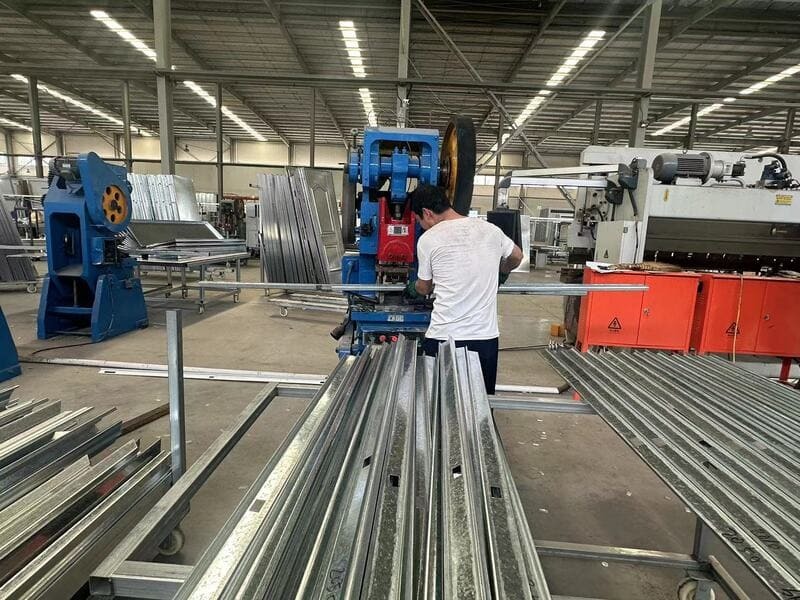
Anti Theft Door Features
Security engineering designed to defeat break-in attempts at residential and commercial entrances.
Multi-Point Locking System
Distributes security across the entire door perimeter with 3, 5, 7, or 12-point systems that engage hardened steel bolts into reinforced strike plates.
- Eliminates single-point-of-failure
- Resists pry bar attacks
- Single key operation
Anti-Drill Cylinder Protection
Hardened manganese steel anti-drill plates positioned around the cylinder pocket cause drill bits to skate rather than penetrate.
- Hardened steel plates
- Rotating anti-drill pins
- High-security cylinders
Anti-Pry Door and Frame Design
Security studs on hinge side engage frame when closed. Anti-pry strips eliminate gaps needed for tool insertion.
- Security studs prevent removal
- Anti-pry strips eliminate gaps
- Reinforced edges resist bending
Reinforced Steel Construction
Cold-rolled steel sheets 1.2mm to 2.5mm with double skins and internal reinforcement ribs welded at critical points.
- Double steel skins
- Internal reinforcement
- Solid core construction
Security Hinge System
Non-removable pins, welded barrels, and dog bolts ensure door remains secured even if hinges are completely destroyed.
- Non-removable pins
- Dog bolts for backup security
- Concealed options available
Anti-Snap Cylinder Technology
Sacrificial break point protects internal mechanism. If snapped, locking function remains intact and secure.
- Sacrificial break point
- Anti-bump design
- Anti-pick pins
Heavy-Duty Security Frame
2.0-2.5mm steel profiles with welded corners, integrated strike pockets, and anti-spread brackets for RC3+.
- Integrated strike plates
- Anti-spread brackets
- Robust anchoring system
Residential-Grade Finishes
Wood grain transfers, powder coating in RAL colors, and real wood veneer options that blend with residential architecture.
- Wood grain finishes
- Interior/exterior flexibility
- Hardware to match décor
Anti Theft Door Security Ratings
Understanding EN 1627 resistance classes for burglar proof door selection.
The European standard EN 1627 defines resistance classes (RC) that specify how long an anti theft door must withstand burglary attempts using defined tools and attack methods. Each class undergoes testing per EN 1628 (static loading), EN 1629 (dynamic loading), and EN 1630 (manual burglary simulation). Selecting the appropriate rating ensures your anti theft door matches the actual threat level and response time available.
Resistance
Attacker Profile: Opportunistic burglar using simple hand tools
- • Screwdriver (max 300mm)
- • Pliers and wire cutters
- • Plastic wedges
- • Small hand saw
Resistance
Attacker Profile: Experienced burglar with additional tools
- • Multiple screwdrivers
- • Crowbar up to 750mm
- • Small hammer
- • Mechanical hand drill
- • Chisel and punch set
Resistance
Attacker Profile: Professional burglar with power tools
- • Heavy hammer and axe
- • Full chisel set
- • Cordless drill with metal bits
- • Portable angle grinder
- • Powered jigsaw
Residential Selection Guide
| Standard residential, low-crime area | RC2 |
| Valuable contents or elevated crime area | RC3 |
| High-value residential or known target | RC4 |
Commercial Selection Guide
| Retail store with standard inventory | RC3 min |
| High-value retail or cash business | RC4 |
All Euwoo anti theft doors are tested by accredited laboratories to EN 1627-1630 standards. Certificates and test reports are provided for insurance documentation and building compliance verification.
Anti Theft Door Specifications
Technical specifications for residential and commercial burglar proof door configurations.
| Specification | RC2 | RC3 | RC4 |
|---|---|---|---|
| Door Leaf Thickness | 50-60mm | 60-70mm | 70-90mm |
| Steel Skin Thickness | 1.2-1.5mm | 1.5-2.0mm | 2.0-2.5mm |
| Frame Profile Thickness | 1.5mm | 2.0mm | 2.5mm |
| Minimum Locking Points | 3-point | 5-point | 7-point |
| Cylinder Security Class | EN 1303 Class 4 | EN 1303 Class 5 | EN 1303 Class 6 |
| Resistance Time | 3 minutes | 5 minutes | 10 minutes |
| Attack Tools Resisted | Simple hand tools | Crowbar, hand drill | Power tools, grinder |
Standard and Maximum Dimensions
Single Door
Double Door
Door Weight by Configuration
| Configuration | Leaf Weight | Frame Weight | Total Assembly |
|---|---|---|---|
| RC2 Single Door (900x2100mm) | 45-55kg | 25-35kg | 70-90kg |
| RC3 Single Door (900x2100mm) | 60-75kg | 35-45kg | 95-120kg |
| RC4 Single Door (900x2100mm) | 80-100kg | 45-55kg | 125-155kg |
Performance Characteristics
Testing and Certification Standards
Anti Theft Technology Systems
Layered security technologies that make our burglar proof doors resistant to common attack methods.
Effective anti theft door design addresses multiple attack vectors through layered countermeasures. Each technology targets specific intrusion methods, from opportunistic lock picking to professional drilling attacks. Understanding these technologies helps specifiers select the appropriate protection level for their application.
Anti-Drill Protection
Attack Method: High-speed drills to destroy lock cylinders, allowing direct manipulation of the locking mechanism.
3-5mm hardened steel plate causes drill bits to skate across the surface rather than penetrate.
Free-spinning hardened steel pins deflect drilling force and cause the bit to wander.
Hardened steel driver pins and key pins that resist drilling within the cylinder mechanism.
Anti-Pick Lock Technology
Attack Method: Specialized tools manipulate cylinder pins to the shear line without the correct key.
Spool pins, serrated pins, or mushroom pins provide false set feedback to picking attempts.
Extremely tight manufacturing tolerances limit tactile feedback available to pickers.
Complex keyway profiles physically obstruct standard lock picks.
Anti-Bump Protection
Attack Method: Bump keys exploit mechanical action - a specially cut key is struck, causing pins to jump to shear line.
Modified pin designs with chambers or undercuts prevent the bounce effect that bump attacks rely on.
Some cylinders incorporate magnetic elements requiring proper alignment bump keys cannot replicate.
Secondary locking mechanisms that must be aligned by the correct key in addition to pin tumbler stack.
Anti-Snap Cylinder Design
Attack Method: Tools break protruding cylinder sections, then manipulate the exposed mechanism.
Predetermined break point in non-critical section. If snapped, internal locking mechanism remains intact.
Even if outer section is removed, remaining cylinder maintains full locking engagement.
Internal section uses thicker, reinforced housing that cannot be further snapped or drilled.
Anti-Pry Construction
Attack Method: Crowbars or spreader tools create separation between door and frame to force door open.
Distributing locking points along full door height means attackers cannot concentrate force at single location.
Continuous steel strips overlap the frame, eliminating the gap needed for tool insertion.
Steel studs on hinge side engage with frame. Even if hinges destroyed, door remains secured.
Anti-Saw Construction
Attack Method: Hacksaws, reciprocating saws, or angle grinders cut through door panels or around locking mechanisms.
1.5mm-2.5mm steel thickness significantly extends cutting time beyond typical attack durations.
Hardened steel rods positioned within door construction obstruct saw blades and cause damage or deflection.
Lock mechanism area incorporates additional armoring that resists cutting attempts.
Integrated Protection System
Effective anti theft doors layer multiple technologies so that defeating one protection does not compromise overall security. Our burglar proof doors integrate all relevant countermeasures appropriate to the specified security rating, creating a comprehensive system rather than relying on individual components.
Lock and Hardware Systems
Multi-point locking configurations and high-security hardware for anti theft door applications.
The locking system determines much of an anti theft door's practical security level. Our burglar proof doors offer multiple locking configurations matched to security rating requirements, from basic 3-point residential systems to comprehensive 12-point commercial installations. All hardware integrates with the door and frame as a tested system.
Locking System Options
3-Point Locking
RC2 StandardEntry-level multi-point security for residential anti theft doors. Engages one bolt at standard lock height plus two additional bolts above and below.
- • Primary mortise lock with deadbolt
- • Upper and lower locking bolts/hooks
- • Gear-driven or lever-operated linkage
- • Integrated handle with cylinder
5-Point Locking
RC2-RC3Adds two additional engagement points at top and bottom. Significantly improves pry resistance by reducing maximum distance between locking points.
- • Central lock body with primary deadbolt
- • Four secondary bolts or hooks
- • Steel linkage rods connecting all points
- • Geared mechanism for smooth operation
7-Point Locking
RC3-RC4Adds hooks on hinge side in addition to five lock-edge points. Creates near-continuous engagement around door perimeter.
- • Main lock body with central deadbolt
- • Four lock-side bolts (top to bottom)
- • Two hinge-side hooks in frame pockets
- • Full-height steel linkage system
12-Point Maximum
RC4+Maximum engagement securing door along all four edges including top and bottom. Specified for vault-level applications.
- • Heavy-duty central lock body
- • Lock-side bolts at multiple heights
- • Hinge-side hooks with frame pockets
- • Top/bottom shoot bolts into frame
High-Security Cylinder Specifications
| Cylinder Type | Grade | Features | Suitability |
|---|---|---|---|
| Standard Security | EN 1303 Class 4 | Hardened pins, anti-pick serrations, basic anti-drill | RC2 anti theft doors |
| Enhanced Security | EN 1303 Class 5 | Anti-bump pins, anti-snap section, rotating anti-drill pins, restricted keyway | RC3 burglar proof doors |
| Maximum Security | EN 1303 Class 6 | Full anti-manipulation suite, magnetic/electronic elements, patented profiles | RC4 and above |
Electronic Access Control Options
Replaces standard frame strike with electrically-controlled release. Fail-secure or fail-safe configurations.
Motorized multi-point locking with electronic control. Remote locking and building management integration.
PIN, card, or biometric authentication with mechanical key backup. Access logging and remote management.
Cable routing, reader mounting reinforcement, and power supply provisions for access control devices.
Handle and Hardware Finishes
Anti Theft Door Construction
Materials and construction methods that define burglar proof door performance.
Door Leaf Assembly
Outer Steel Skins
Cold-rolled galvanized steel, 1.2mm to 2.5mm depending on security rating.
Function: Primary barrier against cutting and penetration. Galvanizing provides corrosion protection.
Internal Reinforcement
Steel channels and box sections, 1.5mm to 2.0mm thickness.
Function: Provides structural rigidity, distributes impact forces, supports multi-point lock hardware.
Lock Zone Armoring
Manganese steel or hardened steel plate, 3mm to 6mm thickness.
Function: Protects lock mechanism from drilling attacks. Hardened alloy deflects drill bits.
Insulation Core
Mineral wool (40-80 kg/m³) or polyurethane foam (45 kg/m³).
Function: Thermal insulation, acoustic dampening, fire resistance. Adds mass and impact absorption.
Security Frame Assembly
| Component | Material | Function |
|---|---|---|
| Frame Profile | Cold-rolled galvanized steel, 1.5-2.5mm | Secure mounting surface with integrated anchor tabs and strike pockets |
| Strike Plate Reinforcement | Welded steel plates, 3mm minimum | Receives lock bolts with material to resist pull-through under attack |
| Anti-Spread Brackets | Heavy-gauge steel brackets (RC3+) | Prevents frame members from being spread using hydraulic tools |
| Anchor Points | Max 400mm intervals | Transfers attack forces into surrounding masonry or concrete |
Steel Grade Specifications
Good formability, consistent surface quality
Standard door skins and framesZinc coating for corrosion protection
Weather-exposed componentsHigher yield strength, impact resistance
Internal reinforcement frameworkWork-hardening alloy, drill resistant
Anti-drill plates around locksExterior Finish Systems
Powder Coating
Wood Grain Transfer
Stainless Steel Cladding
Real Wood Veneer
Anti Theft Door Applications
Burglar proof door solutions for residential, retail, and commercial security requirements.
Residential Homes
RC2-RC3 RecommendedProtect homes and apartment units from break-in attempts while maintaining aesthetic requirements of domestic architecture.
- • Balancing security with aesthetics
- • Protecting against opportunistic break-ins
- • Meeting insurance requirements
Retail Stores
RC3 MinimumMust resist attack long enough for alarm systems to summon response. Professional appearance required during business hours.
- • Protecting inventory after hours
- • Meeting shopping center mandates
- • Fire code compliance
Commercial Offices
RC2-RC3Secure computer equipment, sensitive documents, and assets. Electronic access control integration required.
- • Protecting IT equipment
- • Controlling after-hours access
- • Building code compliance
Pharmacies & Medical
RC3-RC4 RecommendedStore controlled substances and medications. Regulatory requirements mandate specific security measures for drug storage.
- • DEA/regulatory compliance
- • Protecting controlled substances
- • High-traffic durability
Jewelry & High-Value
RC4 RequiredFace sophisticated theft threats requiring maximum security specifications. Insurance mandates specific resistance classes.
- • Extremely high-value inventory
- • Strict insurance mandates
- • Professional-level attacks
Warehouses & Industrial
RC3Store inventory and equipment. Robust doors capable of withstanding harsh industrial environments and intrusion attempts.
- • Protecting stored inventory
- • Industrial environment conditions
- • Multiple access points
Selecting the Right Application Level
The appropriate anti theft door specification depends on asset value, location risk, insurance requirements, and available response time. Our technical team can help assess your specific application and recommend appropriate security ratings, features, and configurations.
Anti Theft Door Customization
Configure burglar proof doors to match your specific security requirements and project specifications.
Size Customization
Stock dimensions: 20-25 day lead time
700-1200mm W, 1800-2500mm H: 30-40 days
Up to 2400mm width: 35-45 days
Engineering review required
Security Level
3-min, 3-point locking. Standard pricing.
5-min, 5-point, anti-drill. Mid-range.
10-min, 7-point, max protection. Premium.
Finish Selection
Full RAL range + custom matching
Golden Oak, Walnut, Mahogany, Grey Oak
304/316 grade, brushed/satin/mirror
Different interior/exterior finishes
Locking Config
3, 5, 7, or 12-point systems
Match existing key systems
Integration with MK hierarchies
Access control provisions
Vision Panels
Laminated glass maintaining rating
Frosted, tinted, patterned options
Maximum security, no openings
Additional Features
Combined 30, 60, 90-minute ratings
Concealed, surface, or floor spring
Thermal break, ADA-compliant options
Stainless steel protection 200-600mm
OEM/ODM Manufacturing
Euwoo provides OEM and ODM services for distributors and project developers requiring private-labeled anti theft doors.
- • Custom branding & labeling
- • Modified specifications
- • Exclusive design development
- • Multi-language manuals
- • Custom certificates
- • Marketing materials
OEM programs typically require 50+ units. Contact for specific requirements.
Custom Order Process
Specification
Provide dimensions, rating, finish, hardware
Technical Review
Engineering review and feasibility confirmation
Quotation
Detailed pricing and lead time
Production
Manufacturing with quality documentation
Delivery
Shipping with certification package
Anti Theft Door Installation
Critical installation requirements for maintaining burglar proof door security performance.
Proper installation is essential for anti theft door security. Studies indicate that approximately 70% of door security failures relate to installation issues rather than product limitations. A correctly specified burglar proof door improperly installed will not deliver its rated performance. The following requirements ensure your anti theft door provides the security protection it was designed to deliver.
Improper installation voids security certification and warranty. Always use qualified installers with documented experience in security door installation.
Wall and Opening Requirements
Acceptable Wall Materials
Min 150mm thickness - Preferred substrate
Min 140mm - Grouted cores required for hollow
Min 190mm - Cores within 600mm must be grouted
Engineering review required
Unacceptable Without Reinforcement
Opening Dimension Requirements
Frame dimensions + 10-15mm on each side
Diagonal measurements within 3mm
Within 2mm per meter height
Frame Installation Procedure
Verify Opening
Check dimensions and squareness. Out-of-square openings prevent proper operation.
Position Frame
Use packers/shims to achieve plumb and level with adequate clearance.
Mark & Drill
Mark anchor positions through frame. Avoid anchor points near mortar joints.
Install Anchors
Tighten progressively, alternating sides to maintain alignment.
Check Alignment
Verify alignment after each anchor. Frame distortion affects security.
Fill Gaps
Use mortar, mineral wool, or fire-rated sealant as required.
Frame Anchor Specifications
Through-bolts or chemical anchors to masonry/concrete
10mm for RC2/RC3, 12mm for RC4
Minimum 80mm into solid material
Maximum 400mm intervals, 4 per jamb minimum
Post-Installation Security Verification
| Verification Check | Method | Pass/Fail Criteria |
|---|---|---|
| Frame Anchor Integrity | Attempt to rock frame in opening | No movement should be detectable |
| Door-Frame Alignment | Verify consistent gap around perimeter | No contact points; door swings freely |
| Locking Point Engagement | Engage lock, verify all bolts extend fully | All bolts must reach strike pockets |
| Cylinder Operation | Lock/unlock multiple times | Smooth operation without binding |
| Anti-Lift Feature | With door closed, attempt to lift | Dog bolts prevent upward movement |
| Seal Compression | Check weatherseal contact | Full perimeter contact when closed |
Wall Reinforcement Solutions
When existing wall construction is insufficient, reinforcement options include:
Steel Sub-Frame
Heavy steel frame welded or bolted to structural elements, providing anchor points for security frame.
For: Retrofit into lightweight wallsConcrete Infill
Pour concrete behind and around opening to create solid anchor substrate.
For: Hollow block or lightweight masonrySteel Plate Backing
Steel plates behind wall surface connected to structural frame.
For: Steel stud wallsAnti Theft Door Comparison
Compare security ratings and features to select the right burglar proof door for your application.
Security Rating Comparison
| Feature | RC2 | RC3 | RC4 |
|---|---|---|---|
| Resistance Time | 3 minutes | 5 minutes | 10 minutes |
| Attack Tools Resisted | Simple hand tools | Crowbar + hand drill | Power tools + grinder |
| Minimum Locking Points | 3-point | 5-point | 7-point |
| Steel Skin Thickness | 1.2-1.5mm | 1.5-2.0mm | 2.0-2.5mm |
| Cylinder Security Class | EN 1303 Class 4 | EN 1303 Class 5 | EN 1303 Class 6 |
| Anti-Drill Protection | Basic | Enhanced | Maximum |
| Anti-Pry Features | Standard | Reinforced | Heavy-duty |
| Door Weight (900x2100mm) | 45-55kg | 60-75kg | 80-100kg |
| Price Level | $ | $$ | $$$ |
| Lead Time | 20-25 days | 25-30 days | 30-40 days |
Residential in low-crime areas, apartment doors, interior secure storage
Retail stores, commercial offices, higher-risk residential, most commercial applications
Jewelry stores, pharmacies, banks, high-value storage, luxury residential
Anti Theft Door vs Other Door Types
| Characteristic | Anti Theft Door | Standard Steel Door | Wood Entrance Door |
|---|---|---|---|
| Forced Entry Resistance | RC2-RC4 certified (3-10 min) | Not tested/rated | Minimal |
| Lock System | Multi-point (3-12 points) | Single point typical | Single point typical |
| Anti-Drill Protection | Hardened steel plates standard | None | None |
| Frame Security | Reinforced with anti-spread | Standard construction | Wood frame typical |
| Insurance Recognition | Meets insurance mandates | May not qualify | Typically insufficient |
| ROI Consideration | Lower insurance + prevented losses | Limited security value | Security upgrade likely needed |
Application Selection Guide
| Application | Recommended Rating | Locking System | Key Features |
|---|---|---|---|
| Residential - Standard | RC2 | 3-point | Anti-snap cylinder, decorative finishes |
| Residential - Enhanced | RC3 | 5-point | Full anti-theft suite, smart lock ready |
| Retail Store | RC3 min | 5-point or 7-point | Fire rating option, vision panels |
| Jewelry / High-Value Retail | RC4 | 7-point or 12-point | Maximum armoring, insurance compliance |
| Commercial Office | RC2-RC3 | 3-point or 5-point | Access control, fire rating for corridors |
| Pharmaceutical / Medical | RC3-RC4 | 5-point or 7-point | Audit-ready access, regulatory compliance |
Quick Selection Matrix
What is the primary threat level?
What is the value of contents?
What response time is available?
Anti Theft Door FAQs
Common questions about burglar proof door specifications, selection, and ordering.
1 Security Ratings & Protection
How do I choose between RC2, RC3, and RC4 anti theft doors?
What does the RC security rating actually measure?
Is an anti theft door necessary for residential use?
2 Product Features
How many locking points does an anti theft door need?
What is anti-snap cylinder technology and do I need it?
Can an anti theft door also be fire-rated?
3 Specifications & Sizing
How heavy is an anti theft door?
What is the maximum size available for anti theft doors?
What steel thickness is used in anti theft doors?
4 Ordering & Lead Times
What is the minimum order quantity for anti theft doors?
What is the typical lead time for anti theft doors?
How is pricing structured for anti theft doors?
5 Installation & Warranty
Can anti theft doors be installed in existing openings?
What warranty coverage is provided on anti theft doors?
Still Have Questions?
Our technical and sales teams are available to answer questions about anti theft door specifications, customization options, and project requirements.